
Yes. AI-generated content can rank on Google. But AI-generated text does not automatically become SEO-friendly content. A page still needs to satisfy search intent, provide accurate and useful information, add something original, demonstrate relevant experience or expertise, support important claims with evidence, and give readers a reason to trust it.
You can open ChatGPT right now, type a topic, and have a 2,000-word article in front of you before your tea gets cold. That part is not in question anymore.
The real question is different.
Can that article actually rank?
I get this question in almost every batch of students I teach, and I get it from working marketers too, usually phrased one of three ways: “Will Google penalize me if I use AI?” “If AI writes better English than me, why should I write it myself?” “Can I publish what ChatGPT or Claude gives me?”
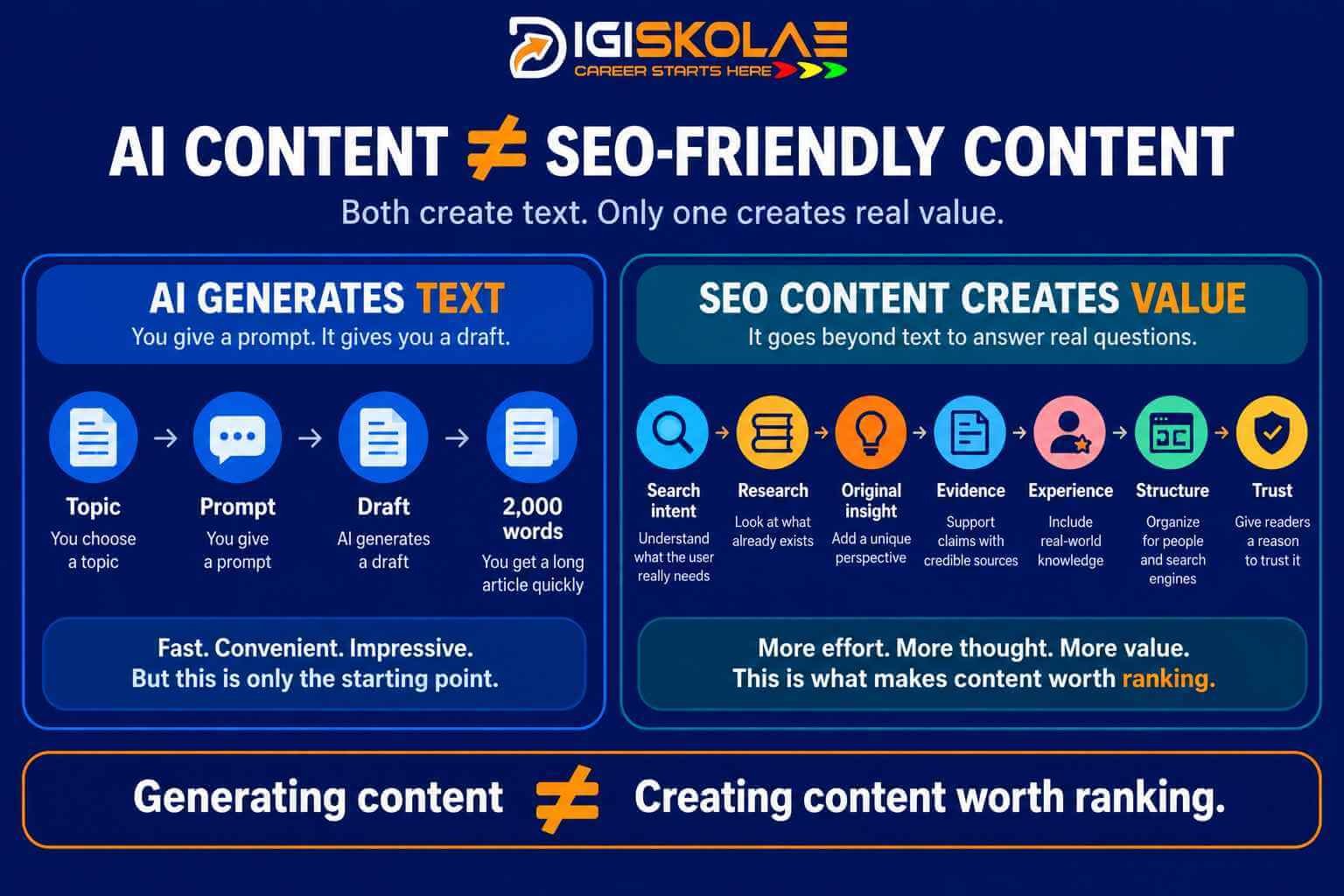
AI can help you produce content, but producing text and creating content worth ranking are two different activities. Most of the confusion around AI and SEO comes from treating them as the same thing.
This article is not going to argue that AI is good or that AI is bad. That debate is less useful than understanding the process. I want to show you how to use AI in an SEO content workflow, what still requires human judgement, and how to decide whether AI-assisted content deserves to be published.
Can AI Actually Write SEO-Friendly Content?
Yes, with a condition attached.
AI assists with producing SEO-friendly content. It drafts, structures, summarizes, reorganizes, and speeds up many mechanical parts of writing. What it does not decide for you is the editorial strategy that separates a page worth ranking from a page that merely exists.
This is where the distinction between AI-generated and AI-assisted content matters. AI-generated content usually means prompt, draft, publish. Nobody checks whether the claims are accurate, whether the examples are specific, or whether the page says anything the top-ranking pages do not already say. AI-assisted content means AI is one part of a longer process that still includes research, strategy, human expertise, verification, and editorial judgement before anything goes live.
Both processes can use the same AI model. The output differs because the thinking behind the process differs.
Can AI-Generated Content Rank on Google?
Yes. Google states that AI use itself is not the deciding issue. Its official guidance about AI-generated content focuses on accuracy, quality, relevance, originality, people-first value, and whether automation is being used to manipulate Search. Google also warns against scaled content production that adds little value.
Google’s current guidance says the same foundational SEO practices apply to AI Overviews and AI Mode. There are no separate technical requirements or special schema rules for appearing in these AI features. Pages still need to be indexed and eligible for normal Search visibility.
Independent research adds useful context. Ahrefs analyzed 1,000,000 pages drawn from the top 10 positions across 100,000 search results in June 2026. In its detected sample, 5.3% of top-three pages were classified as 100% AI-generated and 9% as at least 80% AI content. Pages with under 50% AI content accounted for 82.2% of top-three rankings. Ahrefs also found that low and moderate AI-content pages received roughly two to three times the organic impressions of high or very-high AI-content pages. The study describes these findings as correlations, not proof of an AI penalty.
A separate 16-month experiment from Search Engine Land and SE Ranking followed 2,000 fully AI-generated articles across 20 new domains with no backlinks or authority. About 71% of pages were indexed within the first 36 days and the sites gained early impressions. By roughly three months, only 3% of pages remained in the top 100. The researchers linked the longer-term weakness to missing authority, unique insight, trust signals, and site structure. [6]
Put these studies together and a consistent picture appears. AI-generated content is not automatically excluded from Google. But scaled, unedited AI content on sites with weak authority and little original value has a difficult path to lasting visibility.
What the evidence supports
Do not turn the research into an AI percentage rule. The evidence does not establish a safe 30%, 50%, or 70% AI threshold. The useful lesson is to improve the quality of the page, not to chase a particular AI-content percentage.
What Does “SEO-Friendly Content” Actually Mean?
Most articles list twenty ranking factors and move on. I want you to understand why a smaller set of them matters.
Search intent is the starting point, not an item on a checklist. If someone searches “can AI write SEO-friendly content,” they want a direct answer and a way to think through the decision, not a history of natural language processing. Content that answers a different question has a weak chance of satisfying the searcher, no matter how polished the writing is.
Relevance and accuracy matter because Google and the reader need the page to deliver what the title promises. Confident-sounding text with incorrect facts fails this test even when the prose reads smoothly.
Originality and information gain matter because the SERP already contains answers to most common queries. If your page repeats page-one information in fluent English, you have added competition without adding much value.
Experience and expertise show up through specificity. A page shaped by a real teaching situation, business decision, campaign process, product test, or observation reads differently from a generic explanation.
Structure and clarity exist for the reader. Headings, short paragraphs, useful lists, comparisons, screenshots, examples, and a logical flow help people use the page.
None of these requirements depend on whether AI helped draft a sentence. They depend on whether a human made good decisions about what the page should say and why.
The Real Problem With Most AI-Generated Content
Not all AI content has these problems. But when AI becomes an automated publishing system instead of an assistant, the same weaknesses appear often.
• It repeats what already exists. Models often summarize the consensus around a well-covered topic. Consensus is not information gain.
• It sounds specific without being specific. Phrases such as “many businesses have found success” often appear without a named business, source, date, or measurable context.
• It can contain factual errors with the same confident tone used for correct information.
• It lacks first-hand experience and business context. AI does not know what happened in your classroom, campaign, business meeting, customer interaction, or project unless you provide that context.
• It often produces generic examples. Specific examples require real context and editorial selection.
None of this means AI writing is inherently poor. It means raw AI output tends to drift toward the average of existing information. Ranking-worthy content often needs the opposite: specific experience, evidence, useful judgement, and information the reader did not already have.
What I See When Reviewing AI-Assisted Student Content at Digiskolae
When I review student work at Digiskolae, I do not start by asking whether AI wrote the article. I start by asking whether the student understood the query, studied the SERP, checked the claims, and added something useful from the work they have done.
This difference becomes visible quickly. An AI draft often looks complete on the first reading. The headings are in place, the paragraphs are fluent, and the article covers the obvious points. But when we examine the page as an SEO exercise, the weaknesses usually appear in the decisions behind the writing.
A typical review pattern
The draft answers the topic, but not always the searcher’s exact question. It contains broad advice, but few specific examples. It mentions statistics without always showing where they came from. It explains a process, but does not always show what the student would do next.
The review then moves through five questions:
• What did the student learn from the current SERP before asking AI to write?
• Which parts of the article come from genuine research, and which parts are generic model output?
• Where has the student added first-hand observation, business context, or a practical example?
• Which factual claims have been checked against primary or credible sources?
• What would make this page more useful than the pages already ranking?
One pattern I repeatedly teach students to watch for is the difference between a sentence that sounds knowledgeable and a sentence that gives the reader something they can use.
For example, “AI improves SEO efficiency” sounds reasonable, but the reader still needs to know where AI saves time, where human review is required, and what should be checked before publication. Once students start looking for those missing decisions, their articles change. They stop treating the AI draft as the finished article and start treating it as raw material.
This is also why I do not teach students to chase an AI-content percentage. A page with substantial AI assistance is not automatically weak. A page with little AI assistance is not automatically strong. The editorial question is whether the finished page demonstrates understanding, evidence, experience, originality, and useful judgement.
That is the practical test I want students to carry from the classroom into real SEO work.
If Digiskolae later publishes a formal dataset from student content audits, those findings should be added here with the sample size, review method, date, and actual observations. Until such a dataset exists, the section stays grounded in teaching experience rather than presenting invented numbers as research.
AI-Generated Content vs AI-Assisted Content
AI-generated workflow
Prompt → Draft → Publish
Fast, but missing dedicated stages for research, verification, experience, differentiation, and editorial judgement.
AI-assisted workflow
Research → Search Intent → Strategy → AI Assistance → Human Expertise → Verification → Editing → SEO → Publishing → Monitoring
The AI step is still present. It simply is not the only step. Research happens before the model is asked to write, so the prompt reflects real understanding of the query and SERP. Human expertise and verification happen after the draft, so claims get checked and gaps get filled with information the model did not know. Editing removes generic material and adds specificity.
Same tool. Different result. The difference comes from the decisions around the tool.
What Should AI Do and What Should Humans Do?
This is not about typing every word yourself. It is about deciding where judgement belongs.
AI is useful for:
• Brainstorming angles and questions
• Organizing research you have already gathered
• Producing a first-draft outline
• Writing a rough first pass to react to
• Rewriting for clarity or tone
• Summarizing long source material
• Auditing existing content for gaps or repetition
Humans need to lead on:
• Deciding the strategy and article angle
• Interpreting what the searcher actually wants
• Supplying real expertise, context, and business understanding
• Verifying facts and important claims
• Choosing and writing specific examples
• Making the final editorial decision about what stays, what goes, and what gets published
The human list is shorter but heavier. AI removes typing work. It does not remove the thinking that gives the content a reason to exist.
How to Find Information Gain Before You Write
“Add information gain” is repeated across SEO discussions without always being made practical. Here is a workable process.
1. Search the exact query you are targeting.
2. Open relevant page-one results.
3. Note what those pages answer well.
4. Note what they leave unanswered.
5. Check whether their examples are specific or generic.
6. Look for missing evidence, screenshots, calculations, examples, or implementation steps.
7. Ask what you know from genuine experience that the current results do not show.
8. Decide what useful addition belongs in your article.
The goal is not novelty for its own sake. If a section exists only because competitors do not have it, but the section does not help the reader, leave it out. Information gain means useful additional value, not extra words.
How to Use AI to Write SEO-Friendly Content
1. Understand the search query. Read it from the searcher’s point of view.
2. Study search intent. Decide whether the reader wants to learn, compare, solve, or buy.
3. Analyze the current SERP. See what already answers the query.
4. Identify the gaps.
5. Decide your unique angle.
6. Build the article architecture before drafting.
7. Give AI the research, angle, audience, sources, and examples.
8. Use AI selectively where it saves time.
9. Add human expertise and original information.
10. Verify facts and important claims.
11. Edit for usefulness and clarity.
12. Apply on-page SEO after the content has earned its place.
13. Publish.
14. Monitor performance and improve the page from real evidence.
Steps 4, 5, and 9 often determine whether the article has something useful to add. The remaining steps help you execute that strategy.
What Should You Give AI Before Asking It to Write?
The quality of AI output depends heavily on what you hand the model. Better prompting starts with better thinking.
• Who the reader is
• The exact search query and intent
• What you noticed while studying the SERP
• The specific angle you chose
• Key facts, figures, and sources
• Relevant business or brand context
• Real examples you can supply
• The desired tone
• The action you want the reader to take
If you hand a model a bare topic, you usually get a broad article. If you hand it the topic plus research, audience, evidence, examples, and a clear angle, the draft starts closer to the result you want. Better prompting is often better thinking written down before you open the chat window.
Before and After: Improving Generic AI Content
Telling you AI content can be generic is easy. Showing you is more useful.
Generic AI-generated paragraph
AI-generated content can be a valuable tool for businesses looking to improve their SEO strategy. By leveraging AI, companies can produce content more efficiently while maintaining quality. It is important to strike the right balance between automation and human input to achieve the best results.
Read that again. It says almost nothing. It could sit on almost any business website without changing a word. There is no specific claim, no evidence, no example, and no decision the reader can act on.
Improved version
If your team is publishing more than a handful of AI-assisted articles a month, the risk is not the AI. The risk is the review step disappearing. Before publishing, ask: could this page have been assembled from the first five Google results? If yes, add a sharper example, a fact worth verifying, or a useful step the competing pages skip.
The second version gives a trigger, a concrete test, and an action. It does not merely describe the balance between AI and human input. It tells the reader what to do.
The Digiskolae AI Content Quality Framework
Use this as a final editorial framework before publishing an AI-assisted SEO article.
1. Intent: Does the page answer the real query?
2. Information Gain: What useful information does the page add?
3. Experience: Where does genuine first-hand knowledge appear?
4. Evidence: Are important claims supported by credible sources?
5. Specificity: Are examples concrete and relevant?
6. Accuracy: Have important facts been checked?
7. Differentiation: Why should this page exist instead of another generic article?
8. Actionability: Does the reader know what to do next?
9. Search Readiness: Is the page technically and structurally ready for Search?
10. Citation Readiness: Are important answers clear, sourceable, and easy to understand?
This framework is deliberately broader than an on-page SEO checklist. A page can have the right title, headings, keywords, and internal links and still fail to offer enough value. The framework checks the content before the SEO layer.
The 10-Question AI Content Quality Test
1. Does this answer the search intent, not only the keyword?
2. What does this article add beyond what is already ranking?
3. Is there original insight, or only a fluent summary?
4. Are the examples specific, or could they belong to any business?
5. Have the important claims been verified?
6. Is everything in the article accurate?
7. Does the article demonstrate real expertise where the topic needs it?
8. Is any section repeating common knowledge without adding value?
9. Would this page still be useful if Google did not exist?
10. Does the reader know what to do after reading?
If most answers are yes, move to final publishing checks. If several are weak, improve those sections. If questions 2, 3, and 9 all fail, revisit the article angle instead of polishing sentences.
Does AI Content Need to Be Optimized for Google AI Overviews and AI Mode?
Not through a separate set of AI SEO hacks. Google’s current documentation says the foundational SEO practices used for normal Search also apply to AI Overviews and AI Mode. Pages need to be crawlable, indexable, useful, relevant, and eligible for Search. Google also says there are no additional technical requirements or special schema needed specifically for these AI features.
Google’s generative AI guidance also stresses unique, non-commodity content and warns against producing many query variations primarily to manipulate AI responses or rankings.
For your article, the practical implication is simple. Write a strong page first. Make the answer clear. Support important claims. Add original information. Make the page easy to crawl and understand. Then monitor Search Console and other relevant performance data.
There is no reliable formula such as “write 40-word answers for AI” or “add ten FAQs and Google will cite you.” Treat those tactics as secondary. The content itself needs to earn attention.
How to Make Content More Useful for AI Citation
AI systems differ in how they retrieve and select sources. Still, a few practical publishing habits help your content remain understandable and sourceable.
• State important answers directly before expanding the explanation.
• Use descriptive headings that match real questions.
• Keep definitions precise.
• Separate facts, research findings, author experience, opinion, and hypothetical examples.
• Name the source behind important statistics.
• Use specific examples instead of vague claims.
• Link to supporting pages and authoritative external sources.
• Keep important information in text, not only inside images.
• Build a coherent topic cluster so related pages reinforce one another.
• Make authorship and the author’s relevant background easy to verify.
These practices do not guarantee citation by an AI system. They improve clarity, provenance, and usefulness, which gives retrieval systems better material to work with.
Should You Use AI for SEO Content?
Use AI where it genuinely saves time. Research organization, first drafts, rewriting, summarizing, outlining, and content audits are useful applications.
Keep humans responsible for the decisions that make the content worth publishing: the angle, the evidence, the examples, the experience, the verification, and the final editorial judgement.
AI is a working aid, not a replacement for judgement. The tool does not decide whether content deserves attention. The decisions around the tool do.
This is also how we approach digital marketing education at Digiskolae: understand the strategy first, then use the tools to execute and improve it.
FAQ
