
What a Traditional Digital Marketing Course Actually Teaches You
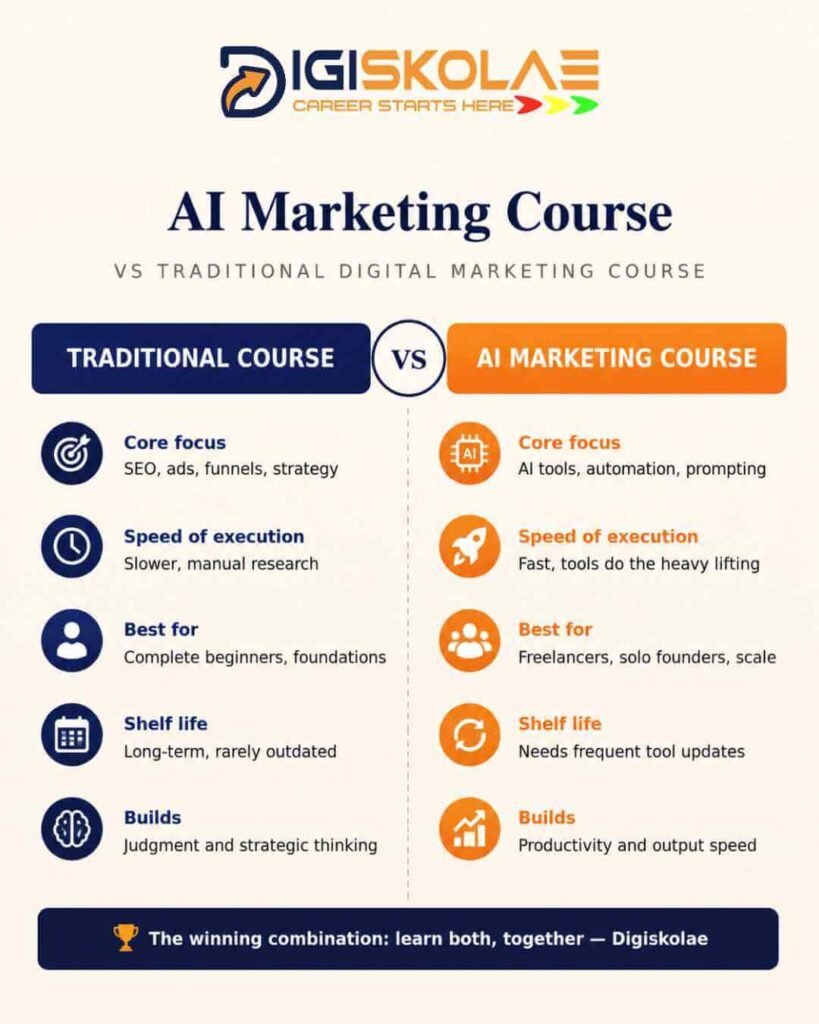
Traditional courses usually cover the foundation — SEO, social media marketing, Google Ads, email marketing, content writing, and basic analytics. Think of it like learning to drive a manual car. It’s slower, sure. But once you understand the gears, the clutch, and the engine, you can drive almost anything.
I remember one of my students, Priya, who did our traditional digital marketing program a few years back. She learned keyword research the old-school way — manually checking search intent, studying competitor websites, building content calendars by hand. It took her weeks to get good at it. Last year she connected me and asked about AI, and I called her for a few classes, and she was quick to pick up the things. She later started using AI tools like SEMrush’s AI features or ChatGPT for content ideas, and she picked it up in days. Why? Because she already understood why certain keywords mattered. The AI tool was just speeding up something she already knew how to do manually.
That’s the real value of traditional learning — it builds your judgment. And judgment is something AI still can’t replace.
Strengths of Traditional Courses
- Strong grip on marketing fundamentals and consumer psychology
- Better understanding of long-term strategy, not just quick execution
- Useful when AI tools change or get replaced (and they will — trust me, this industry changes every few months)
- Helps you spot when an AI-generated output is actually wrong or misleading
But here’s the catch. Traditional courses can feel outdated fast if they don’t update their curriculum. I’ve seen institutes still teaching Facebook ad strategies from three years ago, completely ignoring how much AI has changed content creation and ad targeting.
What an AI Marketing Course Brings to the Table
AI marketing courses focus on tools — ChatGPT, Claude, Jasper, Midjourney, Google Flow, AI-based analytics dashboards, automated email sequences, chatbot builders, and predictive customer behavior tools. The whole point is speed and scale.
Let me give you a real example. A small business owner I consulted with last year was spending almost 15 hours a week writing product descriptions and social media captions manually. After learning basic AI prompting techniques, she brought that down to about 3 hours a week. That’s not a small difference — that’s 12 hours she got back every single week to focus on actual business decisions.
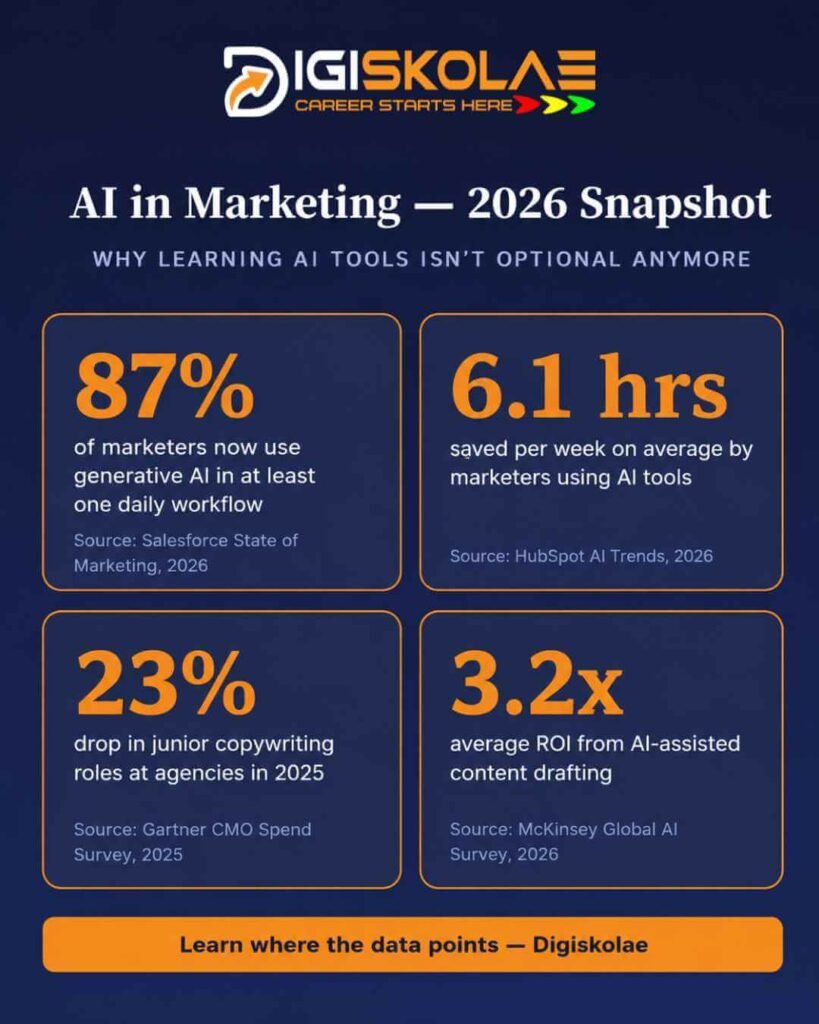
This isn’t just one person’s story either. According to recent data, marketers are now saving an average of 6.1 hours per week because of AI tools, with senior marketers saving even more — around 8 to 10 hours weekly. That’s a full extra working day, basically for free.
And adoption isn’t slowing down. The same report shows that generative AI usage among marketing teams jumped from 51% in early 2024 to 87% by early 2026. That’s a massive shift in just two years. If you’re not learning these tools now, you’re already behind — not in five years, but right now, today.
Strengths of AI Marketing Courses
- Faster content creation and campaign execution
- Better for solo entrepreneurs or small teams with limited manpower
- Helps you compete with bigger companies using fewer resources
- Keeps you updated with what employers are actually asking for in job listings right now
But Here’s the Uncomfortable Truth Nobody Talks About
AI tools are getting so good that companies are actually cutting down on junior-level content roles. One industry report found that 23% of agencies reduced junior copywriting positions in 2025, and 31% plan to cut even more in 2026. Meanwhile, demand for senior strategists — people who can think, plan, and guide AI tools with the right prompts and judgment — keeps climbing.
What does this tell us? If you only learn how to use AI tools without understanding marketing strategy, you’re building your career on shaky ground. AI can write a caption in three seconds. But it can’t decide whether that caption fits your brand voice, whether it’ll actually convert, or whether your target audience will even care.
I always tell my students this: AI is a hammer. A very powerful hammer. But you still need to know which nail to hit, and why.
So Which One Should You Choose?
Honestly? This isn’t really an “either-or” question anymore. Here’s how I’d break it down based on your situation:
If you’re a complete beginner with zero background in marketing, don’t jump straight into an AI-only course. You’ll end up knowing how to use tools without understanding what results actually mean. You need the fundamentals first — even a basic understanding of what a marketing funnel is, or why customer segmentation matters.
If you already have some marketing experience — maybe you’ve run a few campaigns, managed social media pages, or done some freelance work — then adding AI skills on top will genuinely make you 3 to 5 times more productive. This is where AI courses shine the brightest.
If you’re a business owner or planning to start something on your own, you need a mix. You can’t afford to hire ten people. AI tools let one person handle content, basic analytics, ad copy, and customer replies — all at once.
A Simple Way to Think About This
Picture two people applying for the same digital marketing job.
Person A took a traditional course only. They understand SEO, ad strategy, and content planning really well, but they’ve never used AI tools professionally. They’re slower at execution but strong on strategy.
Person B took an AI-focused course only. They can generate content, ad copies, and reports quickly using tools, but they don’t fully understand why a campaign succeeded or failed. They’re fast but shallow.
Now imagine a third person — Person C — who understands both. They know the strategy behind a campaign AND know how to execute it fast using AI. Who do you think gets hired first? Who do you think grows faster as a freelancer or agency owner?
That’s exactly the gap Digiskolae is trying to fill.
What I’d Personally Recommend
Look, I’m not going to pretend this is some neutral, unbiased checklist — I work at Digiskolae, and I’ve seen how our students grow when they learn both sides together rather than picking one path.
A few things I’d suggest checking before joining any course, whether it’s ours or someone else’s:
- Does the course teach actual AI tools with hands-on practice, not just theory slides?
- Is there a strong foundation module on marketing psychology and strategy?
- Do they update the curriculum regularly? (AI tools change every few months — Chat GPT, Claude, and other platforms release new features constantly.)
- Are there real projects and case studies, not just recorded lectures?
- Do they help with placements or portfolio building?
- If a course ticks most of these boxes, you’re probably in good hands.
Final Thoughts
Digital marketing in 2026 isn’t about choosing between “old school and “new school.” It’s about combining both. The market data backs this up clearly — adoption of AI in marketing has grown faster than almost any other technology in this industry’s history, yet the professionals who succeed the most are the ones who pair that speed with real strategic thinking.
I’ve seen students struggle when they only learn tools, and I’ve seen equally talented people struggle when they only learn theory without touching a single AI tool. The ones who genuinely thrive? They learn both, and they keep updating themselves constantly.
If you’re still confused about where to start, that’s completely normal. Almost every student I’ve spoken to felt the same way before joining.
At Digiskolae, we’ve built our digital marketing course specifically to bridge this gap — covering solid marketing fundamentals alongside practical, hands-on AI tool training, real projects, and mentorship from people actually working in this field. If you want to stop guessing and start building real skills that employers and clients are actually looking for right now, check out our AI-Powered Digital Marketing course details on the Digiskolae website or reach out to our team directly. We’ll help you figure out exactly where you stand and what path makes sense for you.
About Author
