
Before we get into it, a number worth sitting with:
Google still handles somewhere around 8.5 billion searches a day, and it holds roughly 90% of global search market share ahead of Bing, Yahoo and DuckDuckGo. But that number is less useful than it used to be, because a growing share of those queries never produce a click. According to a mid-2026 SparkToro study reported by Search Engine Land, 68.01% of US Google searches ended without a single click in the first four months of the year, up from 60.45% in 2024. That’s a jump of more than seven percentage points in two years, and the study points squarely at AI Overviews as the driver. A person asks a question, an AI Overview answers it right there, and the searcher moves on. So the goal of on-page SEO in 2026 isn’t just rank on page one. It’s rank, get picked as the answer, and get cited by name when an AI writes a summary. Those are three separate jobs, and this guide covers all three — I’ve restructured how I write and audit pages around exactly this shift over the last year.
What On-Page SEO Actually Covers
On-page SEO (sometimes called on-site SEO) means everything you do inside your own pages to help search engines and AI systems understand what the page is about and decide it deserves to be shown. It sits opposite off-page SEO, which is about signals from outside your site — backlinks, mentions, reviews on other platforms.
Inside on-page SEO you’ll deal with content quality, title tags and meta descriptions, header structure, URL slugs, internal and external linking, image alt text, page speed, Core Web Vitals, mobile usability, and — increasingly — how clearly your content answers a specific question in the first few lines. Google’s crawler reads your HTML. An AI system reads your paragraphs and pulls out facts it can restate. Both need the same underlying thing: content that is accurate, well organized, and clearly attributed to someone who knows what they’re talking about.
If you want to go deeper than a single article can take you, our Advanced SEO Course in Lucknow covers all of this hands-on, including live audits of real client sites.
Why E-E-A-T Sits at the Center of On-Page SEO Now
E-E-A-T stands for Experience, Expertise, Authoritativeness and Trustworthiness. It comes from Google’s Search Quality Rater Guidelines, the document human quality raters use to judge whether a page deserves to rank. It isn’t a direct ranking factor you can toggle on, but it shapes how Google’s Helpful Content systems evaluate whole sites, and it’s exactly the kind of signal AI answer engines lean on too, since they’re trying to decide whose facts to trust.
Here’s what each letter actually asks for on a page:
- Experience — has the writer actually done the thing? A page about page speed optimization written by someone who has run PageSpeed Insights on fifty client sites reads differently than one written from a template. Show it: mention the tool you used, the result you got, the mistake you made.
- Expertise — does the content demonstrate real subject knowledge, not just correct grammar? Specific numbers, correct terminology, and getting the nuance right (URL structure isn’t just “make it short,” it’s also about keeping it stable so you don’t lose historic backlinks) all signal expertise.
- Authoritativeness — is this source recognized as credible on the topic, by other credible sources? This is partly off-page (who links to you), but on-page you can support it with author bylines, credentials, and citing primary sources like Google’s own developer documentation instead of a random blog.
- Trustworthiness — is the information accurate, current, and transparent? Dated publish and update timestamps, correct facts (getting the FAQ schema situation wrong, for instance, is an easy trust-killer since Google phased it out between 2023 and 2026), and honest sourcing all build this.
A practical example: this very article names its author, states his role, gives a rough number of students trained, and cites Google’s own guideline document by name rather than saying “experts agree.” That’s E-E-A-T applied on-page, not just described.
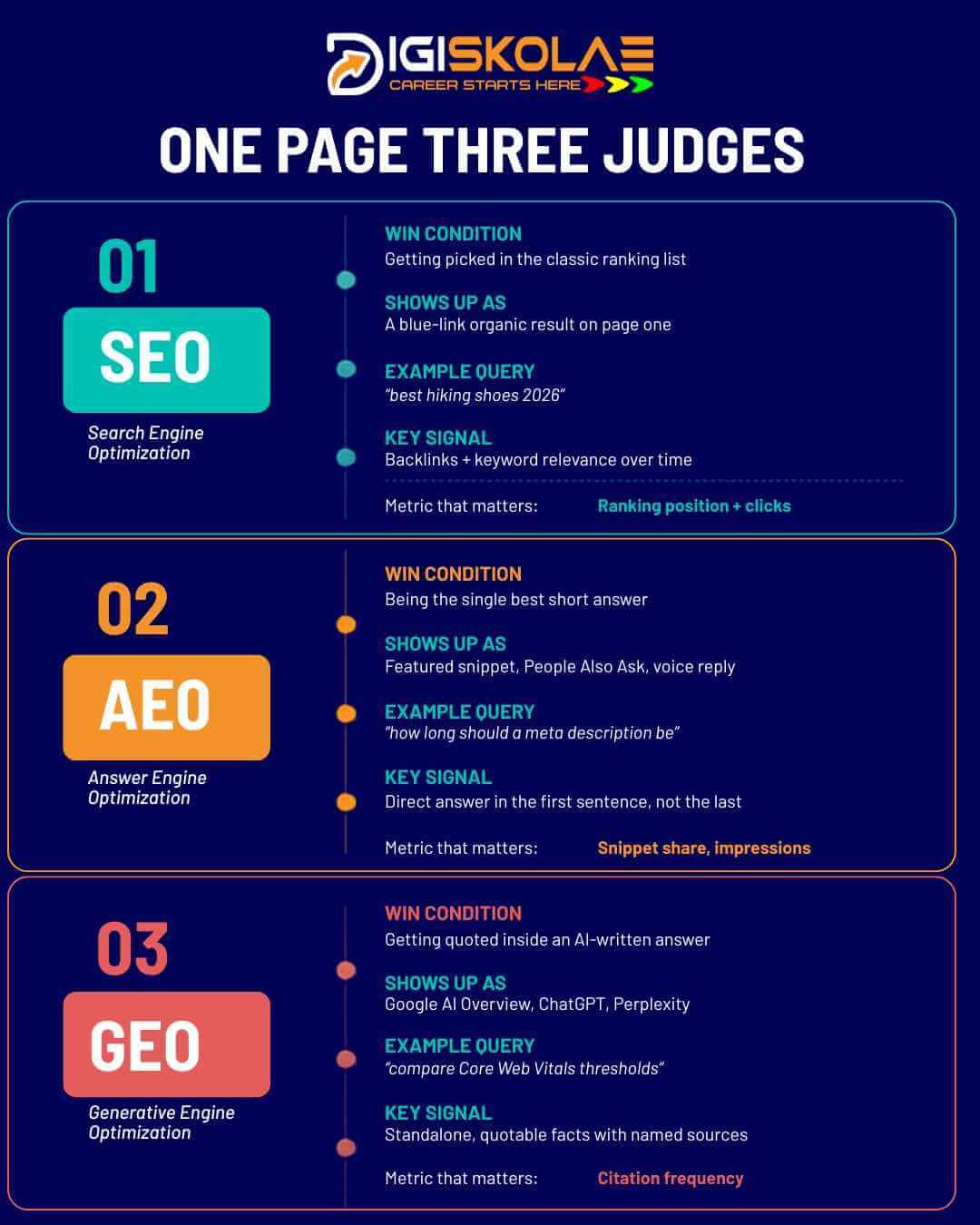
On-Page SEO vs AEO vs GEO — What’s Actually Different
People throw these three terms around like they’re the same thing. They’re related, but the target is different.
- SEO optimizes for ranking in the traditional blue-link results. The win condition is a click.
- AEO (Answer Engine Optimization) optimizes for being the answer pulled into a featured snippet, a voice search reply, or a “People Also Ask” box. The win condition is being selected as the single best short answer to a specific question.
- GEO (Generative Engine Optimization) optimizes for being cited or paraphrased inside an AI-generated response — Google’s AI Overviews, ChatGPT, Perplexity, Gemini, Copilot. The win condition is your fact, your number, or your framing showing up in the AI’s answer, sometimes with a link back, sometimes without one.
Here’s the thing nobody tells you clearly enough:
A page can rank #1 in classic SEO and still never get cited by an AI Overview, because the AI is looking for a clean, extractable fact and your page buried that fact inside three paragraphs of storytelling. Conversely, a page can get quoted heavily by ChatGPT with barely any organic traffic to show for it, because generative engines don’t always send the click.
Example: search “how long should a meta description be.” A traditional SEO article might spend 400 words building up to the answer. An AEO/GEO-optimized version puts “150 to 160 characters” in the first sentence, then explains why. Both versions can rank. Only the second one reliably gets lifted into a snippet or an AI answer.
What On-Page SEO Actually Gets You
It compounds traffic instead of renting it
Ads stop the moment you stop paying. A well-optimized page that answers a real query keeps pulling visitors a year later without another rupee spent, because it’s competing on relevance, not budget.
It’s cheaper per visitor than almost anything else
You’re not bidding against competitors for a keyword auction. You’re improving something you already own — your content, your structure, your load time — and the improvement stays.
It builds trust that ads can’t buy
Ranking organically, especially for competitive terms, signals to a visitor that Google itself vetted you. A neat title, an accurate meta description, and content that actually delivers what it promised all reinforce that.
It improves the experience for the person who’s already there
Clear headings, fast load times, and content that’s easy to scan reduce bounce rate and increase time on page — two things that indirectly help rankings and directly help conversions.
It sets up the AEO and GEO wins described above
A page built with clean structure and direct answers is already halfway to being citation-ready for AI engines. You’re not doing extra work later; you’re doing it once, correctly.
One thing worth being honest about: on-page SEO alone rarely wins a genuinely competitive keyword. It works alongside backlinks, technical SEO and a decent domain history. Anyone promising rankings from on-page changes alone, without touching the rest, is oversimplifying.
The On-Page Elements That Still Carry Weight in 2026
Content — Written for the Reader First, Then Tightened for Machines
Content is still the foundation. If your page about “easy pasta recipes” doesn’t actually contain easy pasta recipes with real steps and real ingredient amounts, no amount of keyword placement saves it.
What’s changed is how the opening should read. Google’s Search Generative Experience, ChatGPT and Perplexity all tend to pull from the first 40-80 words of a section when they’re building an answer. So the old advice — build suspense, tell a story, then reveal the answer — actively hurts you now. Put the direct answer up top. Explain, qualify and add nuance after.
- Use headings, short paragraphs and bullet points so both humans and crawlers can scan the structure
- Place your primary keyword and its close variants naturally, not stuffed
- Answer the actual question in the first sentence or two of any section, then expand
Example: a page targeting “cozy sweaters for winter” should open the relevant section with something like “Merino wool and cashmere blends hold heat best for winter sweaters” — not three sentences of scene-setting before the useful part arrives.
Keyword Research — Now Includes Entities, Not Just Phrases
Traditional keyword research finds the exact phrases people type. That’s still necessary. But modern search engines and AI models understand entities — specific, named things (a person, a brand, a place, a concept) — and connect them to your topic even when the exact phrase isn’t on the page.
Tools worth using: Google Trends, Google Keyword Planner, Ahrefs Keyword Explorer, Ubersuggest, and Answer the Public for question-based queries. For entity research, look at what named things (competitor brands, tools, standards, people) show up repeatedly across the top-ranking pages for your topic, and make sure your content mentions the relevant ones too. If everyone ranking for “best CRM software for startups” mentions HubSpot, Zoho and Salesforce by name, and you don’t mention any specific CRM by name, your page reads thinner to both a crawler and an AI model — even if your advice is good.
Meta Titles and Descriptions — Still Your First Impression
Meta tags haven’t lost relevance; if anything, AI Overviews sometimes still pull the meta description as a starting point for a summary. Keep titles under roughly 60 characters and descriptions between 150 and 160, include your focus keyword naturally, and write them like an actual pitch rather than a keyword dump.
Example: for a hiking blog, a weak title is “Hiking Tips 2026 | Best Trails Guide.” A stronger one is “7 Beginner-Safe Hiking Trails Near Lucknow (With Distances)” — specific, honest about what’s inside, and it front-loads a number, which both readers and snippet algorithms tend to favor.
URL Structure — Boring, Stable, Descriptive
A URL like yoursite.com/blog/post123 tells nobody anything. yoursite.com/hiking-tips-beginners tells everybody everything. Keep URLs lowercase, hyphen-separated, short, and stable — once a URL earns backlinks and rankings, changing it without a proper 301 redirect throws away that equity.
Headings and Subheadings — The Skeleton AI Systems Extract From
H1, H2 and H3 tags aren’t just for looks. AI systems frequently chunk a page by its heading structure and treat each section as an independent candidate for citation. That means each subheading should work almost like its own mini-question, and the paragraph right underneath it should answer that question directly.
Two rules worth following strictly:
- Every heading should describe exactly what the section covers — not a clever pun, not vague (“A Few More Thoughts” tells a crawler nothing)
- Don’t skip levels (an H3 shouldn’t follow an H1 with no H2 in between); it breaks the document outline machines rely on
Internal Linking — Building a Map of Your Own Authority
Internal links tell search engines which pages on your site matter and how topics connect to each other. If you’re writing about “healthy recipes,” linking out to your own pages on “meal prepping” or “grocery budgeting” reinforces topical depth — which both classic SEO and GEO reward, since AI systems tend to trust sites that clearly cover a subject from multiple angles over ones with a single isolated article.
Anchor text matters here too. “Click here” tells a crawler nothing. “our guide to weekly meal prepping” tells it exactly what the linked page is about.
External Linking — Borrowing Credibility, Carefully
Linking out to genuinely authoritative sources — a government health site, a primary research paper, Google’s own documentation — signals that your content is well-researched rather than invented. It also gives an AI model an easy verification path, which slightly increases the odds it trusts and cites your framing of the information.
Don’t overdo it, and don’t link to competitors ranking for the exact same commercial keyword as you. Link to sources that support a claim, not sources that could steal the sale.
Image Alt Text — Accessibility and a Second Ranking Surface
Alt text describes an image for screen readers and for search engines that can’t “see” a picture the way a person does. It should be accurate and specific, not stuffed with keywords.
Weak: “car image.” Better: “red 2026 hatchback parked outside a hill station homestay.” The second version is genuinely descriptive, which helps both accessibility and image search visibility, and it won’t read as spam to a crawler.
Mobile-Friendliness — No Longer Optional, No Longer Impressive
Roughly two-thirds of searches now happen on mobile devices. Google indexes the mobile version of your page by default (mobile-first indexing), which means a desktop-only design flaw is now a ranking flaw, not just an inconvenience. Test with Google’s own Mobile-Friendly checks and fix anything that requires pinch-zooming or horizontal scrolling.
Page Speed and Core Web Vitals — The Technical Backbone
Page speed is measured through Core Web Vitals: Largest Contentful Paint (how fast the main content loads), Interaction to Next Paint (how responsive the page feels when someone clicks something) and Cumulative Layout Shift (whether things jump around while loading). A slow page loses visitors before they read a word, and Google has been explicit for years that speed factors into ranking, particularly on mobile.
Check your numbers with Google’s free PageSpeed Insights tool. Common fixes: compress images, remove unused JavaScript, and use a content delivery network if your audience is spread across regions.
Answer Engine Optimization — Writing So Machines Can Lift the Answer Directly
AEO is about winning the specific spot: the featured snippet, the voice assistant’s spoken reply, the “People Also Ask” expansion. A few practices matter more here than anywhere else in SEO.
Write in a question-and-answer rhythm even without using literal FAQ formatting. Ask the question as a subheading, then answer it in one to three sentences before adding depth. This structure gets pulled into snippets whether or not you use schema markup, because Google’s own guidance now states there’s no special structured data required for AI Overviews or AI Mode — what matters is that the visible text on the page is clean and directly answers the question.
On that note — FAQ and HowTo schema markup have lost most of their old value, and I still see clients paying developers to add FAQ schema thinking it’s a ranking lever. Google restricted FAQ rich results to a small set of government and health sites back in August 2023, and as Search Engine Journal reported, Google stopped showing FAQ rich results in search entirely starting May 7, 2026, with support for the search appearance filter and rich results report being removed from Search Console shortly after. HowTo rich results on desktop were deprecated even earlier, back in 2023. You can still add FAQPage schema without harm — Google says it won’t hurt rankings — but it won’t get you a special dropdown anymore, and there’s no confirmed evidence it improves AI citation either. The dropdown is gone; the value was always in having a genuinely clear answer on the page, and that part hasn’t changed.
A short list of what actually helps AEO in 2026:
- Numbered steps for anything procedural (steps, ranks, sequences)
- Definitions stated in one clean sentence before you elaborate
- Tables for comparisons — AI systems extract tabular data cleanly
- Direct numeric answers (“150 to 160 characters,” not “a moderate length”)
Generative Engine Optimization — Getting Quoted by AI Overviews, ChatGPT and Perplexity
GEO is the newest layer, and it works differently from classic SEO in one important way: generative engines don’t care about your keyword density, they care about whether a specific sentence on your page is quotable, accurate, and attributable.
A few things that consistently improve citation odds:
- State facts as standalone sentences that make sense out of context — a sentence like “Meta descriptions should stay between 150 and 160 characters” can be lifted whole; a sentence buried in narrative can’t be
- Include original data where you can — a stat from your own audit, your own survey, your own client results, gets cited more than a repeated statistic everyone else already has
- Name your sources and your author clearly, since generative engines weigh attribution and credibility signals when deciding which of five similar pages to quote
- Keep facts current and correct — an AI model that catches your page stating outdated information (say, claiming FAQ rich results still work the old way) is less likely to trust anything else on the page
- Cover a topic from more than one angle on the same site, since generative engines lean toward sources that show consistent depth rather than a single lucky article
Example: two competing pages both explain Core Web Vitals. Page A says “site speed matters for SEO.” Page B says “Largest Contentful Paint should load within 2.5 seconds; anything past 4 seconds is classified poor by Google.” Page B gets cited. It gave the model something specific enough to restate as fact.
How SEO, AEO and GEO Fit Into One Page (Without Writing Three Versions)
You don’t need three separate articles. You need one article built in layers:
- Open each major section with a direct, quotable answer (serves AEO and GEO)
- Follow it with depth, nuance, and original examples (serves classic SEO and E-E-A-T)
- Name real entities, tools, and sources throughout (serves topical authority for all three)
- Keep the technical basics — speed, mobile, clean URLs, alt text — solid, because none of the newer layers matter if the page doesn’t load or index in the first place
A Quick Checklist Before You Hit Publish
- Does the first sentence of the page or section answer the actual question, before any setup?
- Is the author named, with a credible reason to be writing this?
- Are headings specific enough to double as mini-questions?
- Is at least one fact on the page a standalone, quotable sentence?
- Have you named real tools, brands, or sources rather than speaking in generalities?
- Does the page load fast on mobile — checked, not assumed?
- Are internal links pointing to genuinely related pages with descriptive anchor text?
- Is any FAQ schema on the page treated as harmless extra structure, not a ranking strategy?
Where This Leaves You
On-page SEO hasn’t gotten smaller — it’s gotten split into three related jobs instead of one. Rank in classic search, get picked for the direct-answer spot, and get cited when someone asks an AI instead of Google. The pages that manage all three in 2026 tend to share the same habits: they answer first, explain second, name real things instead of vague ones, and they’re honest about who wrote them and why that person’s opinion should count.
If you’d rather learn this by doing it on live client sites instead of reading about it, our Advanced SEO Course in Lucknow runs through on-page audits, AEO structuring and GEO content design as part of the curriculum.
